November 2026 · Urban Surf NW · Wing Foiling · Parawings
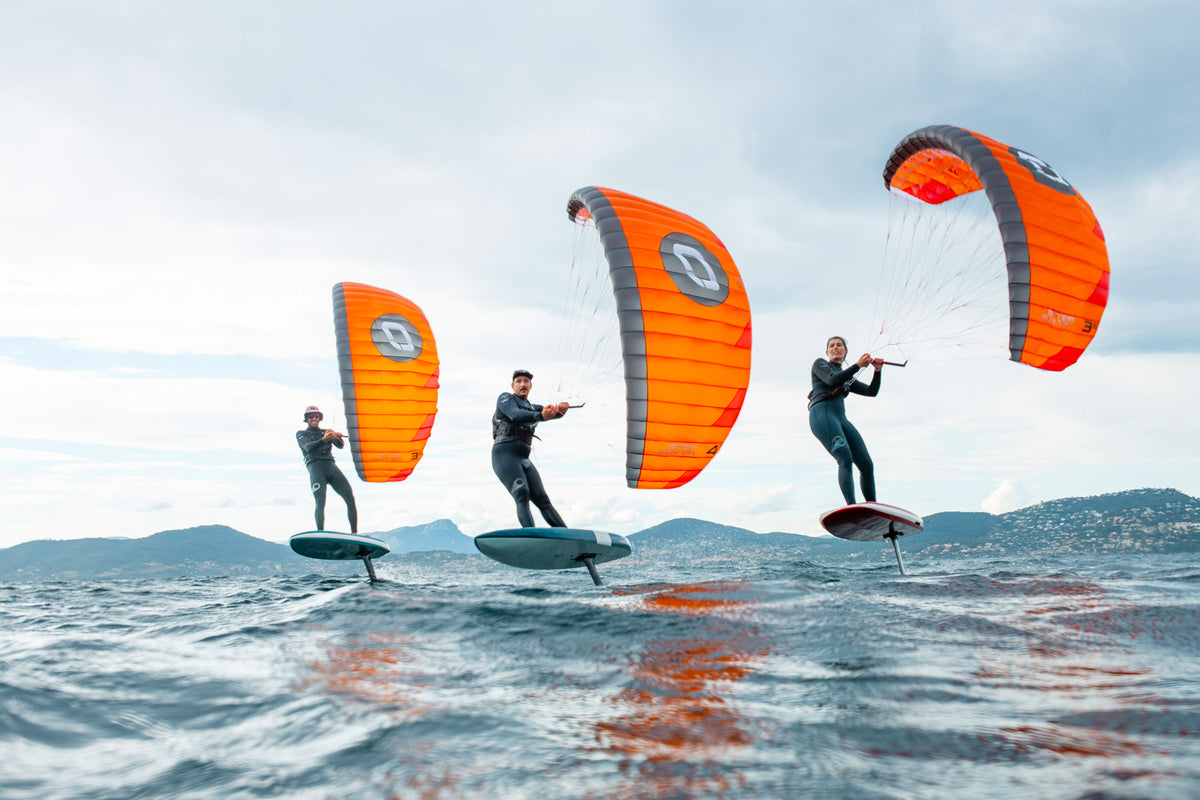
A parawing is a canopy on lines with no bladders in it, which means there's nothing to pump up, nothing to burst, and nothing stopping you from balling the whole thing up and shoving it down your front while you keep riding. That last part is the entire point. We carry three brands' worth of them now, Ozone, Duotone and F-One, and they are genuinely not interchangeable. This is which one does what.
What is a Parawing?
If you already wing foil, the mental model is easy: take your inflatable wing, delete the leading edge and the strut, delete the pump, and run the canopy on lines to a bar or a harness instead. What you lose is the rigid handle you grab without thinking about it. What you gain is a wing that packs down to roughly the size of its own stuff sack.
That size is what changes the session. Once the bump starts running you stash the canopy, ride the swell like you're on a downwind board, and redeploy when the bump quits. An inflatable wing can't do that, because an inflatable wing is a piece of furniture you're holding. A parawing goes away and comes back. Ozone's pitch for their fastest model is just "start your session at your finishing point," hammer upwind, then ride the biggest run you can, and for anyone who has tried to organise a shuttle driver for a Point Wilson run on a Tuesday, that's the whole argument.
Worth the obvious caveat before anyone gets too excited. This is not where you learn to foil. Duotone says it in their own product copy, which I appreciate: "Don't expect Parawinging to be as easy as Wing Foiling – it's not!" The thing that actually catches people is the bridle. Duotone's own safety note is worth reading twice: the lines are thin, they can tangle around hands and fingers in breaking waves, and once the canopy loads up, getting free isn't quick. Both brands tell you to practise on land first, and both are right.

Two Stash V2s getting flown on the grass before we try it on the water.
Ozone: Differences across models
Ozone is the deep end of this category and the only brand here where you can pick by riding style rather than by what happens to be sitting on a shelf. Their current range is four parawings: the PowerPack, the Pocket Rocket V2, the Pocket Rocket V2 Ultra-X and the Afterburner. We carry three of them. We don't carry the Ultra-X, which is the featherweight light-wind build aimed at riders who already know how to handle delicate gear.
What makes Ozone easy to write about is that they publish the comparison themselves. In a range guide dated the 22nd of October, their design team scored all four wings against each other on the same ten-point scale. No other brand in this post does anything like it, and the numbers are more honest than most marketing.
| Ozone's own score, out of 10 | PowerPack | Pocket Rocket V2 | Afterburner |
|---|---|---|---|
| Beginner | 10 | 9 | 3 |
| Upwind | 7 | 9 | 10 |
| Speed and drive | 4 | 8 | 10 |
| Wave | 10 | 10 | 5 |
| Stashability | 10 | 9 | 7 |
| Redeployment | 10 | 9 | 7 |
| Race | 1 | 6 | 10 |
Ozone's design team's own scoring, from their range guide of 22 October 2026. Not mine. The fourth model, the Pocket Rocket V2 Ultra-X, is left out because we don't carry it.
PowerPack — power up, pack down
$1,169 for the 3m up to $1,299 for the 5m · Ozone builds 1.9 through 5m

The PowerPack is the simplest wing Ozone builds, and the simplicity is the design rather than a cost saving. A lower cell and rib count than the Pocket Rocket makes it lighter and physically smaller, so it bundles without precise handling and opens cleanly when you throw it back out. Ozone's phrase for the session it's for is "stash & glide, redeploy & ride" — short laps, where the wing spends about as much time in your belt as in the air. Andy Corbe, one of their testers, reckons he's got up on foil and collapsed it in around ten seconds.
Looking down the lines on a PowerPack. Short bridle, not much canopy to manage.
Upwind is where it gives something back, and Ozone is straight about the size of it. They score it 7 against the Pocket Rocket V2's 9, and their wording is that the PowerPack's upwind is reliable but the V2 "drives further forward and covers ground faster." Reliable, not weak. If your session is laps and swell, that's plenty. If it's a long grind back up the beach, get the V2.
One more thing Ozone says out loud that most brands wouldn't: the light build that makes it stash so well also wears faster. "The knocks of the learning phase (crashes, dragging and repeated contact with the water) will wear it faster than a Pocket Rocket V2." It's a great wing to learn on and it will show you learning on it.
Pocket Rocket V2 — Ozone's Golden Boy
$1,119 for the 3m, $1,199 for the 4.3m · Ozone builds 1.9 through 5.7m

If you only take one line out of Ozone's range guide, take the one they print three times: "If in doubt, choose the Pocket Rocket V2." It also won AWSI's Innovation of the Year award for 2026, which Ozone puts down to how fast it gets people riding rather than to any single spec on the sheet.
Against the PowerPack it's better upwind, wider range, and more comfortable once you're overpowered. Jeff and Tucker at MACkite, who have put a serious run of recent sessions into testing parawings back to back, call it "a great all-around go-to." Against the V1 it's a redesign rather than a refresh: shorter bridles borrowed from the PowerPack, a new Bow Bar with the central leader line deleted so your hands can sit anywhere along it, a lower-aspect shape that's less likely to catch a tip in the water, and diagonal ribs at the front that spread load off the leading edge into the sail. Dom Zimmermann, who leads Ozone's design, says the sweet spot got bigger and "less sensitive to handling errors," and that the stall point now sits considerably further back when you point downwind.
The honest bit comes from Ozone too. It stashes faster than the V1 but, in their words, "not as quick as PowerPack," and it bundles small without bundling PowerPack-small. That's the trade you're making for the upwind.
See the Ozone Pocket Rocket V2 →
Afterburner — the fast one, and read the small print
$1,599 for the 3m up to $1,809 for the 6.5m · Ozone builds 2.4 through 6.5m

The Afterburner is Ozone's high-aspect model and the brief was narrow on purpose. Their stated aim was "to make the fastest parawing with the best upwind performance on the market," and Axel Mazella, who works in their R&D department, won races on it at Defi Wing this year.
The number that actually separates it is cell count. The Afterburner runs 23 to 25 cells depending on size, against the Pocket Rocket V2's 14 to 18, with a fully supported rib structure behind them, and that's what keeps the canopy clean when it's loaded. You can see what that buys in the published wind ranges: a 4.3m Afterburner is rated 14 to 30 knots, a 4.3m Pocket Rocket V2 is rated 14 to 25. Same bottom end, five more knots on top. It ships with a 90-gram monobloc carbon bar at 35cm and a 25cm harness line, and Ozone is clear that hooked in is how it's meant to be ridden.
MACkite took a 4.3m out in 16 to 22 knots and Jeff's read was that it felt like a fast, racy sports car, with light bar pressure and what Tucker called phenomenal VMG. Their more useful observation is that the range is wide enough to replace two wings, which sounds like a brochure line until you look at the numbers above.
Now the small print, because it's real. Ozone scores its own wing 3 out of 10 for beginners, 5 for wave riding, and 7 for both stashability and redeployment, the lowest stash scores anywhere in their range. Zimmermann again: it "takes a little more care and consideration due to the more complex design such a high rib count and bridle layout... when rapid stash and deployment aren't the top priorities." MACkite found exactly that on the water. More cells, a wider canopy and bigger battens mean it takes an extra beat to stow and a bit more room in the pouch. If your session involves stashing the wing twenty times, this is the wrong wing.
Pocket Rocket V1 — superseded, discounted, still the most cost effective door in
$617.40 for the 1.9m and 2.4m, $659.40 for the 3m · originally $999 to $1,099

Worth being straight about this one. The V1 has been replaced by the V2 and Ozone has taken it off their site altogether; the old product page is a 404. Ours are marked down hard against their original prices.
What you give up is the V2 list above, read backwards: longer bridles and a slower packdown, a bar with a central leader line running through where your hands want to be, a higher-aspect shape that catches a tip more easily, a smaller sweet spot. None of that makes it a bad wing. It's the wing that got a lot of people into this sport in the first place, and at a bit over six hundred dollars it's a genuinely cheap way to find out whether parawinging is for you. Just buy it knowing which one it is, rather than working it out afterwards.
See the Ozone Pocket Rocket V1 →
Duotone: the Stash, both generations
Stash V2: $1,059 for the 2.2m up to $1,209 for the 5.6m · Stash V1: $685 to $790.30, originally $929

Duotone were early to this and the Stash is a genuinely well-liked wing. There are two of them now, the original and a 2026 redesign, and we carry both. They look alike in a product photo and they don't ride alike, so here's how to tell them apart.
Ken Winner designed the first one, working with downwind riders Finn and Jeffrey Spencer. The canopy is a 30-gram paragliding ripstop rather than kite or wing cloth, which Duotone chose deliberately because it flies earlier, stays up longer and packs smaller, and the V1 runs closed-cell double-skin tips. Jeffrey Spencer's own line on them: the double skin tips "add stability when flying both powered and depowered."
The V2 started as a list of complaints. In a MACkite tech talk this January, Spencer went through what the design team set out to fix in the V1: efficiency once fully powered, weak upwind, instability in high wind, a narrow usable wind range, slow drainage from the double-surface tips, line tangling, and fatigue on long sessions. That's a more honest list than most brands will read out about their own wing.
Here's what they changed. The double-surface tips are gone entirely, so it drains fast. The lines are stiffer, sheathed to tangle less, and shorter, with a three-line front bridle and internal ribs in the leading edge. There's a new C-shaped carbon handle that lets your fingers slide under the A-lines for more depower, a built-in harness line, and no exposed Velcro. The sizes moved too, 2.2 through 5.6, so the two are easy to tell apart on a rack, and the 2.8m weighs 585 grams. Tucker Vantol at MACkite flagged the water-holding tips on the V1 back in 2025, so this is Duotone fixing something riders actually reported.

Stash V2 overhead in the shorebreak, board under the other arm. No pump, no leading edge, just canopy and lines.
The Inertia's test panel put the V2 in their "Best of the Rest" group and called it "a highly usable, and solidly capable parawing with good range." Their knocks: the VMG isn't best in class, and it "can get a little unstable as it gets overpowered."
So which one. Size for size the V2 is about four hundred dollars more, $1,149 against $720.30 for a 4m. The V1 is still the cheapest real parawing in this post by a wide margin, and it's a good wing. If waterlogged tips and tangled lines are the things you'd actually mind, that's what the extra money buys.
F-One: Standalone design
This is the section where it's easiest to get sold the wrong product, so it's worth slowing down. F-One make two things that sit on the same shelf and they are not the same category of object.
Frigate — the actual single-skin parawing
$1,199 for the 3.5m, $900 for the 4.7m, $1,369 for the 5.5m

The Frigate is the real thing: single skin, harness-based, 600 grams with the bar in the 3.5m, packs very small, fully stashable for hands-free swell riding. The construction borrows from paragliding, with mini-ribs and diagonal D-ribs structuring the profile so it needs fewer bridles, and a hydrophobic-coated Porcher canopy. Riders describe its strength as efficiency rather than grunt: it gains altitude quickly and builds apparent wind well as the speed comes up.
A Frigate up and flying on a grey, gusty day.
The Inertia's test panel ran about twenty-five parawings across fifteen-plus brands this year and called the 2025 Frigate their overall best of that season, praising the upwind performance, the wind range, the stability, the refly and the lineset. Their criticism was that the lines are a bit longer than they'd like. Erwan at GlissEvolution tested one too and his one real complaint is specific and useful: you can't fully kill the pull. "The Frigate neutralizes better than most wings, but there's always a slight pull remaining," which matters most when you're in the water caught between the board and the wing.
The other thing to know is generational. F-One has replaced it with the Frigate 2, so ours is one version back, and it is still listed close to original pricing on most sizes. If long downwinders and a wing that disappears into your waistband are why you're reading this, the Frigate is F-One's answer and it's a good one. Ask about the 4.7m first.
Plume — more power, easier, but doesn't fully stash
$1,009 for the 3.5m, $1,099 for the 4.2m

The Plume is a hybrid, and F-One doesn't file it under parawings at all. It gets its own category, K-Wing. It has a small inflatable leading edge and no centre strut, and that one structural difference drives everything else. It weighs about a kilo in the 4.2m against the Frigate's 600 grams, it's bulkier, and critically it cannot be fully stashed.
In exchange you get more base power, a simpler bridle, better control at the top end, and a friendlier way into freefly riding. F-One's own ratings say it plainly enough: ease of use 100%, top end 100%, packing 50%. Bowen Dwelle reviewed it for The Inertia and his summary is the clearest version of the trade — it "blazes upwind like an inflatable wing, reaches free and easy like a strutless kite," at half the weight of most inflatable wings, while giving up the stowability. His warning is that the low end is limited, so size up relative to the inflatable wing you'd normally reach for.
So it's a legitimate pick as long as you're picking it for those reasons. If you buy a Plume because you read an article about stashing a wing mid-ride, you've bought the wrong product.
Side by side
Short version before the table: most people want the Pocket Rocket V2, and Ozone says so too. People doing serious distance want the Afterburner and should accept a slower stash for it. People on a budget want one of the two marked-down previous-generation wings and should know that's what they are.
| Model | What it is | Built for | Sizes built | Price |
|---|---|---|---|---|
| Ozone Afterburner | Single skin, high aspect, 23–25 cells | Max upwind, speed, distance | 2.4–6.5m | $1,599–$1,809 |
| Ozone Pocket Rocket V2 | Single skin, 14–18 cells | Do-it-all freeride | 1.9–5.7m | $1,119–$1,199 |
| Ozone PowerPack | Single skin, fewest cells and ribs | Hot laps, stash and glide, waves | 1.9–5m | $1,169–$1,299 |
| F-One Frigate (prev. gen) | Single skin, 600g with bar at 3.5m | Long downwinders, compact stash | 2.5–6.5m | $900–$1,369 |
| F-One Plume | K-Wing. Inflatable LE, ~1kg at 4.2m | Accessible freefly, more base power | 2.5–6m | $1,009–$1,099 |
| Duotone Stash V2 | Single skin, no double-skin tips, sheathed lines | All-round, fewer tangles | 2.2–5.6m | $1,059–$1,209 |
| Duotone Stash V1 (prev. gen) | Single skin, double-skin tips | All-round, value | 2–6m | $685–$790.30 |
| Ozone Pocket Rocket V1 (prev. gen) | Single skin, superseded by the V2 | Cheapest way in | 1.9–5m | $617.40–$659.40 |
Sizes listed are what each brand builds, not what's sitting here this week. Not sure which way to go? Come in and we'll talk it through, or take a demo out first.
What else you need
A parawing on its own isn't a session, and Ozone says this to every rider including beginners: pair it with a harness line and a harness or a belt. Their claimed payoff is less upper-body fatigue, better upwind, and longer sessions, and that matches what everyone who rides one will tell you.
So: a harness line at $42, in 25, 30 and 35cm, and a harness hook at $25, because on most of these the load wants to go through your harness rather than your arms. Then a stash belt, which is the thing that makes the stash part work at all, since it's where the balled-up canopy actually goes so it isn't loose in your wetsuit. Ozone's is $109, Larrabee Gearworks make one at $180, and Manera's Pocket Wing Belt is $219. And a swivel leash line at $36, which earns its keep the first time you'd otherwise have wound your leash into a spring.
One naming warning, because it will bite someone: there are two different products called "Parawing Stash Belt V2" from two different brands. The one you can actually buy from us is the Larrabee.
Our Take

The Good. The category does the thing it advertises. The wing packs to nothing, stashes mid-ride, and turns a windy afternoon into a downwinder with no shuttle driver.
The Bad. Nothing here wins at both ends. Ozone's own scorecard has the PowerPack at 10 for stashing and 7 for upwind, and the Afterburner exactly reversed. And the bridle is what bites new riders: Duotone's own copy warns the thin lines can tangle round your hands in breaking waves and be slow to get free.
First one? Pocket Rocket V2. It's the most forgiving when you're overpowered, which is when you'll be making mistakes.
Doing distance? Afterburner, and accept the slower stash.
Curious but not convinced? The marked-down Pocket Rocket V1, or the Duotone Stash V1. Or take a demo out.
Come Try One
We carry all eight of these, and we run a demo fleet, which given the learning curve is the honest way to start. Come put your hands on a bar before you spend anything.
(206) 545-9463 · 2100 N. Northlake Way, Seattle